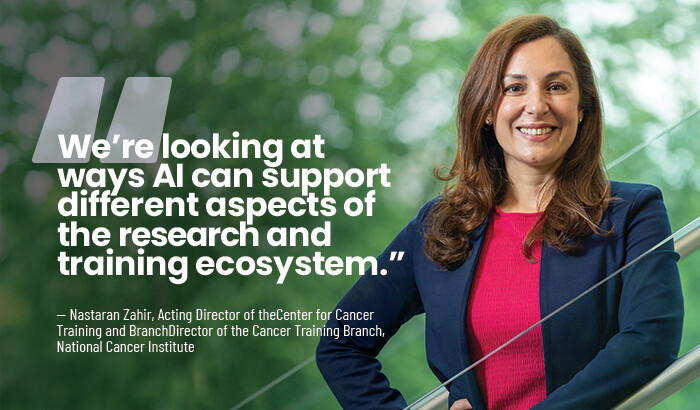







“NanCI is one of our most visible applications of large language models,” Zahir says. “We’re looking at ways AI can support different aspects of the research and training ecosystem, whether it can help with knowledge discovery or administrative efficiency. NanCI provides a valuable model for how these technologies can be applied in a practical and user-centered way.”
Medical research-associated LLM use has expanded in recent years due in part to the models’ increasingly nuanced architecture and the availability of healthcare and biomedical data, such as electronic health records, says Wes Anderson, quantitative medicine scientist at the Critical Path Institute, a nonprofit that works with researchers and other entities to accelerate drug development.
The current generation of LLMs — which can make connections between different words in a sentence and be trained to respond to prompts and follow instructions — are being used to address bottlenecks that involve language and knowledge synthesis, Anderson says.
Today’s Language Models Can Enable Faster Fact Finding
Organizations might use prebuilt models from providers or adapt and host models in their environment for specific tasks.
“You’re able to build tools on top of them and do things like create retrieval-augmented generation pipelines that you can give direct access to the information, run some code to answer some of the questions you may be interested in or generate code,” Anderson says.
After NanCI’s introduction, NCI added Ask NanCI, a feature that lets researchers interact with scientific content in a conversational way.
“You can ask any question — for example, ‘Tell me the major outcome of this paper,’ or a specific question about a figure in a paper,” Zahir says. “Ask NanCI will use the information in it and large language modeling to generate a response.”
DISCOVER: How IT infrastructure modernization supports federal agencies.
Google Cloud provides the underlying cloud infrastructure and access to LLMs that power the Ask NanCI function, Zahir says, and also assists with updates to NanCI, which is available as an iOS app and web application that’s accessible on any device, including Android smartphones.
“NanCI has the potential to become a more integrated part of the research ecosystem — hopefully helping not just with discovery but with collaboration, identifying trends and perhaps even helping inform research directions,” she says. “It represents a shift toward an AI-native scientific infrastructure, where AI tools can actively support how science is done, rather than just storing information.”