Federal agencies are under increasing pressure to modernize physical security systems that were originally designed around centralized video monitoring and passive recording. Those legacy deployments often struggle to keep up with today’s requirements for real-time threat detection, cybersecurity hardening and efficient data management.
At the same time, any new technology must meet strict federal procurement standards. The Axis Q1728-LE network camera, part of the Q17 Series, addresses both challenges by combining edge-based intelligence with Trade Agreements Act-compliant availability.
LEARN MORE: Extend data center value with third-party hardware support.
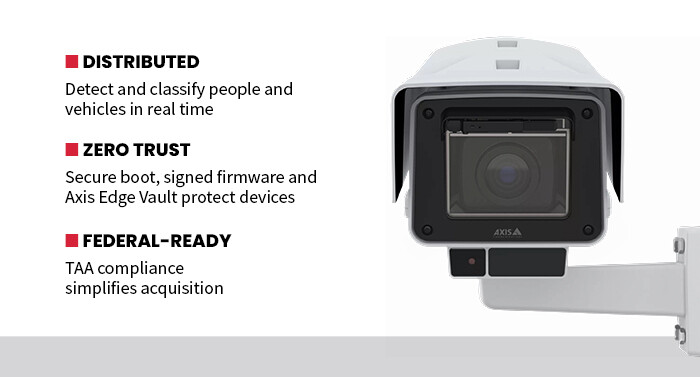
At the center of the Axis Q1728-LE is a built-in deep learning processing unit that allows the camera to analyze video in real time. Instead of sending all footage back to a central server for processing, the system can detect and classify objects such as people and vehicles at the device level.
In my testing, this capability made it possible to identify relevant activity immediately without waiting for upstream analysis. That kind of responsiveness can be critical in high-security environments such as courthouses, research facilities or transportation hubs.
The Q1728-LE Provides Impressive Image Quality
The image quality itself is equally strong. The Q1728-LE delivers up to 4K resolution at high frame rates, producing clear, detailed footage even when subjects are in motion. During evaluation, the camera maintained consistent clarity across a range of lighting conditions, and its imaging features preserved usable detail in outdoor scenarios.
The addition of a built-in wiper and heater further supports reliable operation in challenging weather conditions, ensuring visibility is maintained in rain, dust or extreme temperatures.
One of the more significant advantages of the platform is how it reduces reliance on constant video backhaul. With Axis Object Analytics running directly on the camera, agencies can focus on meaningful events rather than continuously streaming all footage to centralized systems. Combined with Zipstream and AV1 compression technologies, the Q1728-LE can significantly reduce bandwidth and storage requirements while still retaining critical forensic detail. For large federal deployments, that efficiency can translate into measurable cost savings over time.
Click the banner below to ensure your agency is ready for physical security threats.
Hardware-Based Protection
Cybersecurity is another area where the Q1728-LE aligns well with federal priorities. The camera incorporates secure boot and signed firmware to ensure that only trusted software can run on the device. Axis Edge Vault provides hardware-based protection for sensitive cryptographic operations, helping safeguard device identity and integrity. These features support a zero-trust approach to physical security, where every device must be verified and continuously protected against tampering or compromise.
In practice, these protections are not just theoretical. During my evaluation, firmware updates were applied securely and without disruption, reinforcing the platform’s ability to maintain integrity over time. For agencies concerned about supply chain risk and device-level vulnerabilities, this type of built-in security architecture is increasingly important.
As a box camera, the Q1728-LE can also be paired with different lenses to support a wide range of federal use cases, including monitoring perimeters and facility entrances and long-range observation. This flexibility allows agencies to deploy a consistent platform across diverse environments while tailoring coverage to specific operational needs.
Federal Agencies Are Cleared to Buy
Equally important, the availability of a TAA-compliant model removes a major barrier to adoption. Federal agencies can move forward with deployment knowing the device meets procurement requirements, avoiding delays that often accompany noncompliant technologies.
Overall, the AXIS Q1728-LE demonstrates how physical security is evolving beyond passive surveillance. By combining high-resolution imaging, edge-based analytics, hardened cybersecurity features and federal procurement readiness, the platform enables agencies to respond faster, operate more efficiently and strengthen their overall security posture without requiring a complete infrastructure overhaul.