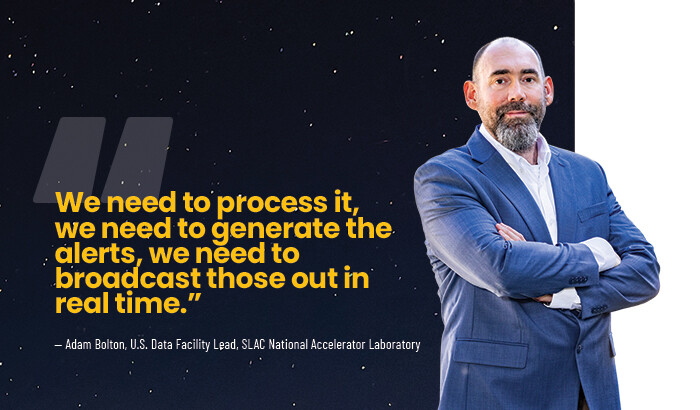
The observatory is heavily dependent on software, and the “as a service” nature of the cloud supports the team’s needs in that arena as well. “It allows you to try things out and learn from experiments,” Bolton says.
“If one approach doesn’t work, you haven’t sunk a bunch of capital into some purchase that turns out to be the wrong call,” he says. “You can spin that down and spin up something else. It allows for a much more rapid iteration and improvement cycle.”
Tracking the Weather
The National Oceanic and Atmospheric Administration generates a vast amount of environmental information via satellites, radars, ships and weather models. The NOAA Open Data Dissemination uses commercial cloud partners such as Amazon Web Services (AWS), Google Cloud and Microsoft Azure to make that data readily available for both scientific discovery and for commercial users.
“Historically, NOAA’s data has been very valuable to businesses, to the public and to other government agencies — but it’s been very inaccessible, very hard to discover,” says retired Rear Admiral Timothy Gallaudet, who formerly served as both deputy administrator and acting administrator at NOAA.
“The big challenge is the volume of data. NOAA generates a terabyte of data a day, and it’s spread across multiple sites, organizations and geographic locations,” says Gallaudet, now the CEO of marine technology and management consultancy Ocean STL Consulting.
With vast infrastructure and scalable compute capabilities, cloud plays a key role in making that data “more discoverable and easily downloaded,” he says. “Now anybody can access any amount of data, anywhere — and at speeds that are much faster, because of the computing powerhouses that those cloud vendors provide.”
READ MORE: What’s next in the cloud?
Ready availability of NOAA’s weather data has a direct impact on the nation. From hurricane season on the East Coast to atmospheric rivers on the West Coast and drought in the Southwest, “having more data available for researchers is going to help us speed the research, improving models that predict those storms,” Gallaudet says.
The data also drives ocean mapping in the U.S. Exclusive Economic Zone, a 3.4-million-square-nautical-mile maritime area surrounding the nation’s coastline. “Mapping the ocean allows you to manage fisheries, to update nautical charts for safe navigation, to conserve coral reefs and monitor harmful algal blooms,” he says — and the power of the cloud is making that possible.
Observing the Earth
Beyond the weather, there’s a lot going on here on Earth that scientists want to understand, from shifting ocean currents to changes in the atmosphere, shrinking forests and soil erosion.
NASA’s Earthdata Cloud leverages AWS to share that data with the scientific community. Agency documents say the cloud enables users to work with larger data sets and collaborate more effectively on in-depth research efforts. Cloud supports open-source tools that benefit the scientific community, and it delivers enhanced data management capabilities.
A cloud-based approach also eases IT management for the agency, says Knepper.
“If you’ve got a data center that’s owned by NASA or another agency, then you’ve got to manage all the ins and outs of it,” he says. With Earthdata Cloud, AWS manages the infrastructure. Cloud also “helps solve the problem of scale,” with the capacity and flexibility to make vast amounts of data readily available to interested researchers.