Close

New Workspace Modernization Research from CDW

See how IT leaders are tackling workspace modernization opportunities and challenges.

Feb 06 2026
Networking

Federal Agencies Embrace Networking as a Service to Modernize Their Networks

CISA and VA show how cloud services can simplify modernization, strengthen security and provide flexibility to scale.

At the Cybersecurity and Infrastructure Security Agency (CISA), CIO Robert Costello is leveraging the power of Network as a Service, or NaaS — a network-management model in which a third-party provider does the heavy lifting.

“Instead of me rolling out all of my own software to manage a network and that infrastructure, we can consume very secure and capable cloud provider networks delivered as a service,” Costello says. “As we look at deploying taxpayer dollars effectively, a lot of these commercial providers can do it better than I can, faster and cheaper.”

Experts say the current push for government efficiency elevates the value of NaaS for federal agencies.

“It’s a cloud model that enables users to easily operate their networks and achieve critical outcomes without having to own, build or maintain infrastructure,” says Mike Witzman, vice president of solutions engineering for the U.S. public sector at Cisco.

Click the banner below to dive into CDW's latest cloud research.


NaaS Offers More Agility With Connectivity

CISA first used NaaS to enable Wi-Fi. “Now, we’re using it throughout our infrastructure stack. We completed our cloud migration out of our legacy data centers. Now, our facilities, where our users and operators sit, are under a cloud-focused network management plan,” Costello says.

The agency is the sponsor of Cisco Meraki’s FedRAMP Moderate authorization. With that solution in place, “I’m offloading things that we don’t have to do anymore, like rolling out our own management systems for a network, or rolling out security upgrades,” he says.

It can be argued that NaaS has been a long time coming in the federal space. When Joshua McKenty served as NASA’s chief cloud architect from 2008 to 2010, he stood up a network management capability in support of cloud usage. NASA then went on to become an early NaaS provider to other federal agencies.

“We were hosting workloads for other agencies. We were very much in this service provider model, providing virtual networking along with computing and storage,” McKenty says.

Robert Costello


Today, agencies look to a number of commercial providers to fill that role. The Department of Veterans Affairs, for example, is a sponsor of Juniper Mist FedRAMP-Moderate Government Cloud.

“VA is adopting Network as a Service across our enterprise to modernize campus Wi-Fi and LAN services,” says VA Press Secretary Pete Kasperowicz.

“Instead of managing every component through traditional lifecycle refreshes, we consume these capabilities as a service, which gives us more agility in how we deploy, secure and scale connectivity,” he says.

Keeping Pace With Growing Demand for Network Services

In the federal space, NaaS delivers a range of operational benefits.

At VA, the “as a service” approach gives the agency flexibility. “This model helps us keep pace with growing demand for network services in healthcare environments and ensures that our facilities — from the largest hospitals to the smallest outpatient clinics — have consistent, reliable and secure access to the network,” Kasperowicz says.

Click the banner below to keep up with the IT, cyber and AI experts making government efficiency a reality.


NaaS allows VA to quickly adapt to operational needs, “whether that’s supporting surge capacity in a hospital or enabling rapid setup of new facilities,” he says. It also drives more effective network management, “with a single pane of glass for visibility and observability across the entire enterprise, allowing us to manage performance, security and user experience consistently — no matter the location.”

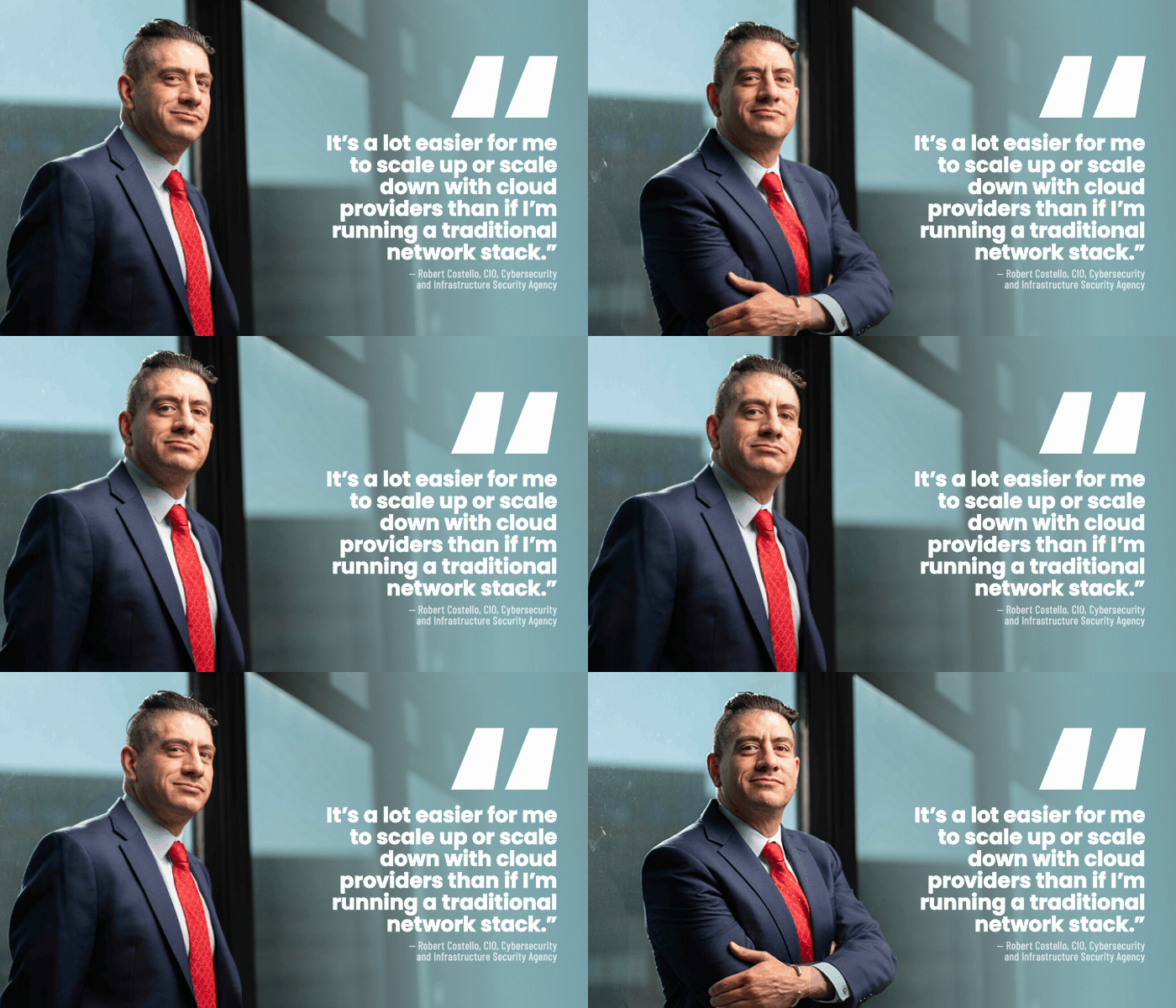
At CISA, NaaS makes it possible to adapt to changing demand patterns. “It’s a lot easier for me to scale up or scale down with cloud providers than if I’m running a traditional network stack,” Costello says.

Moreover, NaaS helps to keep his protections current.

“When you work with any of these providers, you benefit from the power of both their government work and their commercial work for cybersecurity threats that they’re seeing,” Costello says. “They’re constantly adjusting, rolling out new solutions, rolling out new capabilities on their cloud side, a lot faster than if we were running this as a government, off-the-shelf software project.”

Click the banner below for the latest federal IT and cybersecurity insights.


Others point to enhanced security as another key benefit. “There are economies of scale in security. Done well, a really good security operations center takes a lot of people, and a NaaS provider can amortize that over a ton of clients,” McKenty says.

With NaaS, “by the time it’s affecting you, they already know how to deal with it, because they’ve already been dealing with it for the last 24 or 36 or 72 hours. You really get the benefit of them as an early warning system,” he says. “For most government agencies, outsourced security is just going to have better insights than they will ever have in-house.”

Allowing Network Engineers to Be Better Network Engineers

A number of best practices can help agencies to make the most of a NaaS approach.

Costello says agencies should take advantage of the opportunity NaaS provides to put people onto higher-value tasks.

DISCOVER: Recent cloud security developments present government with fresh opportunities.

“It’s an augmentation,” he says. With NaaS handling the routing tasks of network management, “this allows the network engineers to be even better, so they can do real-time troubleshooting and packet captures. It’s allowing my network engineers to be even better network engineers.”

At VA, Kasperowicz encourages agencies to make thoughtful use of the baked-in AI capabilities in NaaS.

“AI allows us to identify anomalies, predict issues and even self-heal certain problems before users are impacted,” he says.

AI in NaaS delivers its best value “when it is paired with strong observability and automation practices,” he says, “but it depends on high-quality data and well-integrated systems.” Agencies that focus on data and integration to enable those AI capabilities will get greater value from a NaaS solution.

UP NEXT: Self-healing networks offer optimized performance.

McKenty, meanwhile, says there is good reason to take a fresh look at the org chart as agencies pivot toward the “as a service” model.

“Network as a Service isn’t just shifting the operating model and getting off buying hardware and into leasing services. You’ve got to align your human resources to that as well,” he says.

“This impacts how we’re accessing storage. This impacts how we’re doing provisioning of security updates. Every site security plan has a set of controls that are now going to go onto this new vendor,” he adds. “This is going to take a lot of alignment.”


Photography by Jonathan Thorpe