Federal agencies are under both growing mission demands and escalating cyber-risk. They must not only store and protect enormous volumes of data across on-site, cloud and edge locations, but also need to ensure seamless access, secure sharing and compliance with federal mandates. And the legacy storage silos, point solutions and static infrastructures that agencies used to rely on are straining under those pressures.
That’s where NetApp ONTAP can help out. It’s a unified data operating system built for both hybrid and multicloud operations. Designed for highly regulated and secure environments, the platform has been hardened for zero trust and certified for government use.
ONTAP provides a consistent management plane whether the deployment is in a data center, GovCloud region or edge device cluster. In a test environment, it was able to unify the management of multiple data types, workloads and applications, regardless of where they were running. Managing an application at the edge was just as easy as one operating in the cloud or even on an on-prem array.
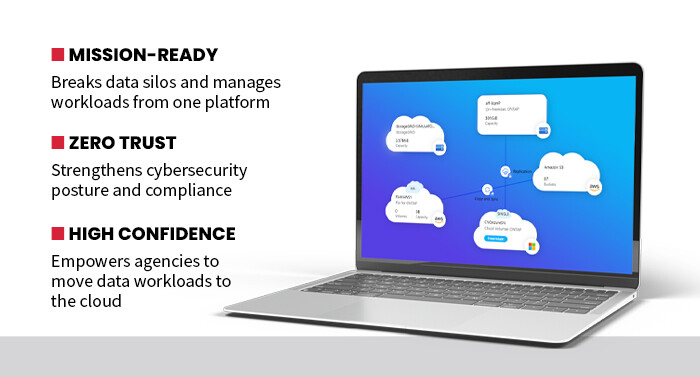
Click the banner below to learn more about moving to a hybrid cloud model.
Scalability Reducing Management Burden and DOD-Level Security
The ONTAP tools such as Snapshot and FlexClone also performed well. For example, we were able to achieve near instant recovery of data while also reducing our overall storage footprint using deduplication and automatic cloud data tiering. For feds, having that scalability and unified control would reduce the management burden for federal IT staff managing complex, distributed infrastructures.
In fact, using ONTAP to unify data management would allow agencies to begin to fully modernize their storage and data infrastructures without having to rip and replace tons of legacy equipment. For agencies wrestling with fragmented storage landscapes, that would mean fewer silos and a clearer roadmap for cloud-enabled mission services.
From a security and compliance perspective, ONTAP also scores strongly. AWS’s Amazon FSx for NetApp ONTAP earned both FedRAMP High and Moderate impact level authorizations, making it one of the few platforms that can operate all the way up to high-security environments. For DOD agencies, it was certified using the DOD Security Requirements Guide (SRG) for Impact Levels 2, 4 and 5. All of that means that both civilian and defense agencies can use ONTAP to move sensitive workloads over to managed services in the cloud while preserving all federal compliance requirements.
WATCH: These are the top hybrid infrastructure trends in 2026.
Removing Migration Barriers and Unifying Complex Environments
Of course, no advanced platform is going to be a perfect fit out of the box. Agencies considering ONTAP should review their existing data architecture, network connectivity and cloud readiness. While ONTAP removes many common migration barriers, effective data governance, lifecycle policies and change management remain critical to realize full value.
Likewise, consuming managed ONTAP services (such as FSx for ONTAP) may require agencies to adjust their procurement, security monitoring or operations models. Even so, the end result would almost certainly be worth that effort, especially for agencies struggling to manage extremely complex environments.
For federal agencies moving from siloed storage to a data-centric, mission-ready infrastructure, ONTAP presents a compelling, future-proof option. It ties strong cyber resilience, hybrid-cloud flexibility and unified data services into a single platform built for government demands.
SPECIFICATIONS
PRODUCT TYPE: Data management software and unified storage platform
DEPLOYMENT: On-premises, hybrid and cloud
SUPPORTED ENVIRONMENTS: NAS (NFS/SMB), SAN (iSCSI/FC/NVMe-oF), object (S3), container, hybrid-cloud, multicloud
CAPABILITIES: Unified file/block/object support, tamperproof snapshots and clones, automated tiering, global deduplication, cloud tiering, integrated data protection, zero-trust security architecture, autonomous ransomware detection
ADDITIONAL TOOLS: AI-powered operational services (via NetApp Console) analytics/observability (via Data Infrastructure Insights), cybersecurity hardening compliance packages